


Edwin Herbert Land didn’t just invent a camera. He invented a way to see time slow down.
The story starts before the cameras. It starts with light. In 1932, Land and his partner George Wheelwright founded Land-Wheelwright Laboratories. Their goal was simple. Make light polarizers. Not for art. For science. Specifically, an inexpensive plastic sheet that could cut glare.
By 1936, that science became sunglasses. People loved them. They didn’t have to squint at the sun anymore. The company incorporated as Polaroid in 1937. The name stuck because the technology did too.
Then came the war.
The 1930s and 1940s were busy. Polaroid built three-dimensional motion-picture processes. They also created polarized optical devices for military use. You don’t build high-tech optics for fun. You build them for strategy.
But Land had a bigger idea. He wanted to remove the wait.
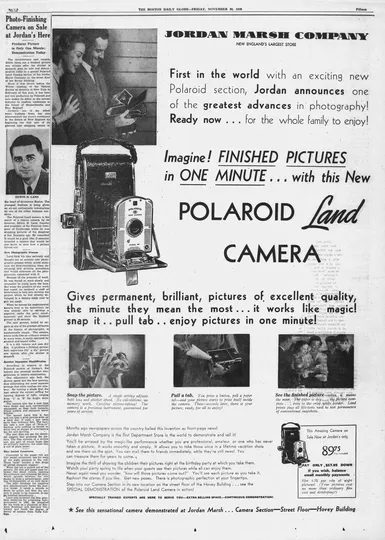
Chemists call it “instant.” Consumers called it magic. In 1947, the Polaroid Land camera hit the market. It changed everything. You took a picture. You watched it develop. No darkroom. No waiting days for a lab.
The first prints were sepia-toned. They took 60 seconds to appear. Sixty seconds feels like an eternity in photography. It forces you to look at the result immediately. You can’t hide behind the shutter click.
The technology evolved quickly. The 1950s brought black-and-white prints in just 15 seconds. Faster. Sharper. The 1960s introduced color. And film cartridges. This was huge. You didn’t have to mix chemicals in your bathroom anymore. You just swapped the pack.
Then came the SX-70 in 1972.
This wasn’t just a camera. It was a compact marvel. It folded up. It became pocket-sized. It produced both negative and positive prints on a single sheet. One photo. Two versions. Immediate physical proof.
In 1977, they tried instant motion pictures. It didn’t take off the way still photography did. But the core idea remained.
Land died in 1991. The corporation he founded had already reshaped how people capture memories. They made photography tactile. Immediate.
We still talk about the click. The slide. The waiting.
Why do we miss the delay?

The Slow Death of a Icon
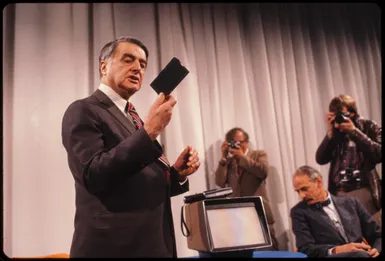
Edwin H. Land had been gone from the chair since 1980. That didn’t stop the machinery from churning.
In the years following his retirement, Polaroid wasn’t just sitting on its laurels. The company pushed into professional labs and consumer homes with a sprawling catalog. You had high-speed film. Floppy disks (yes, really). Medical imaging gear. Security systems that verified identity. Transparent cameras. It was a sprawling empire of analog precision.
Then came the legal knockout.
In 1986, Polaroid scored a massive $925 million judgment against Eastman Kodak. A patent infringement win. It was the highest sum ever awarded at the time for such a case. The money likely kept the lights on, but it didn’t fix the creeping rot inside.
The 1990s brought flashes of brilliance. They introduced cameras with built-in storage compartments. They redesigned the Polaroid OneStep, which became a worldwide best seller. It was nostalgic, tactile, and profitable. But the ground was shifting.
In 1996, they released their first digital camera.
It should have been the pivot. It wasn’t.
By 2001, the writing was on the wall. Polaroid filed for bankruptcy. The consensus? They failed to embrace digital technology. They clung to instant film while the world moved on. It wasn’t just poor strategy; it was a refusal to let go.
Assets were stripped. Sold off to OEP Imaging Corporation in less than a year. They created a shell company: Primary PDC, Inc. It kept the name “Polaroid” alive. OEP became Polaroid Holding Company (PHC).
Two years later, in 2005, Petters Group Worldwide bought PHC.
The company remained in bankruptcy protection until 2006. This is where it gets bizarre. For those two years, Polaroid had no employees. No operations. No factories humming. But the brand? The brand was still being leveraged. It was licensed out to foreign manufacturers. You were buying “Polaroid” electronics made elsewhere, with no connection to the original company’s engineering or ethos.
By 2007, cameras were gone. The hardware that defined a generation ceased.
Then came the final blow for the analog faithful.
In 2008, Polaroid announced the end. They would permanently cease production of instant film by early 2009. The chemistry. The smell. The physical print. All gone.
But here’s the twist. Later in 2008, the parent company, Petters Group, filed for bankruptcy too.
Yet, oddly, Polaroid continued to manufacture and market new products.
How? The brand had become a ghost. A license. A promise of quality that no longer existed in substance. The company that once invented the instant photo had become a marketing vector for goods it no longer controlled.
It’s a cautionary tale about brand equity. You can sell the assets. You can strip the employees. But if people still buy the name, the ghost keeps walking.

