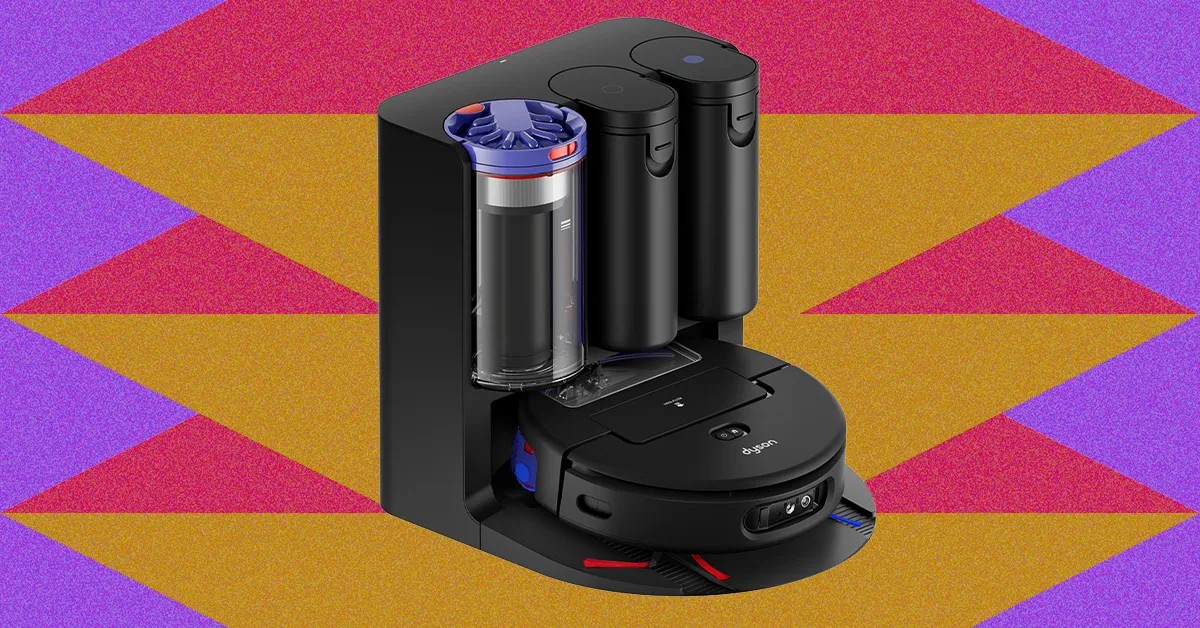
Dyson has officially entered the robot vacuum and mop market with the Spot+Scrub Ai. While the device brings the brand’s signature engineering and a distinct aesthetic to the automated cleaning space, real-world testing reveals a machine caught between high-end AI promises and the physical limitations of modern home layouts.
The Design: A Distinctly Dyson Approach
The Spot+Scrub Ai distinguishes itself immediately through its hardware. Unlike the minimalist docks seen on many competitors, Dyson has opted for a large, multi-functional base station.
- The Homing Station: The dock features three visible cylinders—one for clean water, one for dirty water, and a clear container for dry debris.
- The Benefit of Visibility: While the clear debris bin might be an “eyesore” in a living room, it offers a practical advantage: you know exactly when it needs emptying.
- Sustainability: By using a bagless design, Dyson avoids the recurring cost and waste associated with the disposable bags found in many other robot vacuums.
The “Tall Boy” Problem: Navigation and Clearance
The most significant drawback of the Spot+Scrub Ai is its physical profile. Standing at approximately 4.25 inches tall, the vacuum struggles with the common “toe-kick” areas under kitchen and bathroom cabinets, which are often only 4 inches high.
This height creates a specific intelligence gap. Because the cabinet overhangs are just out of the camera’s line of sight, the AI often misinterprets the clearance. This leads to the robot repeatedly bumping into furniture it should be avoiding. Furthermore, the vacuum lacks an extendable arm to reach these tight edges, leaving many nooks and crannies uncleaned.
Navigation Challenges:
* Mapping Limitations: While the vacuum maps floors quickly (about five minutes per floor), the Dyson app lacks precision. It struggles to detect specific furniture like kitchen islands, forcing users to manually “guesstimate” object placement on the map.
* Getting Stuck: The vacuum’s tendency to wedge itself under low bed frames or cabinets can lead to it becoming stuck, requiring manual intervention.
* Multi-Floor Logistics: If you live in a multi-story home, the workflow is somewhat cumbersome. The robot does not automatically empty or dry its mop pads when moved between floors without a dock. To ensure the machine cleans and dries itself properly, users must save the floor with the docking station for last.
AI and Scrubbing: Does the Tech Deliver?
The “Ai” in the product name refers to its HD camera and artificial intelligence, designed to identify and treat stains in real-time. The theory is that the AI will detect a mess, calculate the necessary intensity, and perform targeted scrubbing.
In practice, the results are mixed:
“It’s difficult to tell if the AI-driven scrubbing is actually working; in tests, it failed to remove stubborn sticky residues even after multiple passes.”
Compared to competitors like Shark, which often perform a dedicated “re-run” specifically for stains, the Dyson attempts to scrub during its initial cleaning pass. This makes it harder to verify if the AI is effectively distinguishing between a mere discoloration and a deep-set stain.
The Competitive Landscape
Dyson is entering a crowded market where brands like Dreame and Shark have already set high benchmarks for smart navigation and specialized cleaning modes. While the Spot+Scrub Ai is a capable device—especially for homes with high-clearance furniture—it faces stiff competition from robots that offer more intuitive mapping and more aggressive stain-treatment protocols.
Conclusion: The Dyson Spot+Scrub Ai is a high-quality, aesthetically unique hybrid that performs well on open floors, but its height and mapping limitations may frustrate users with complex, low-clearance home layouts.