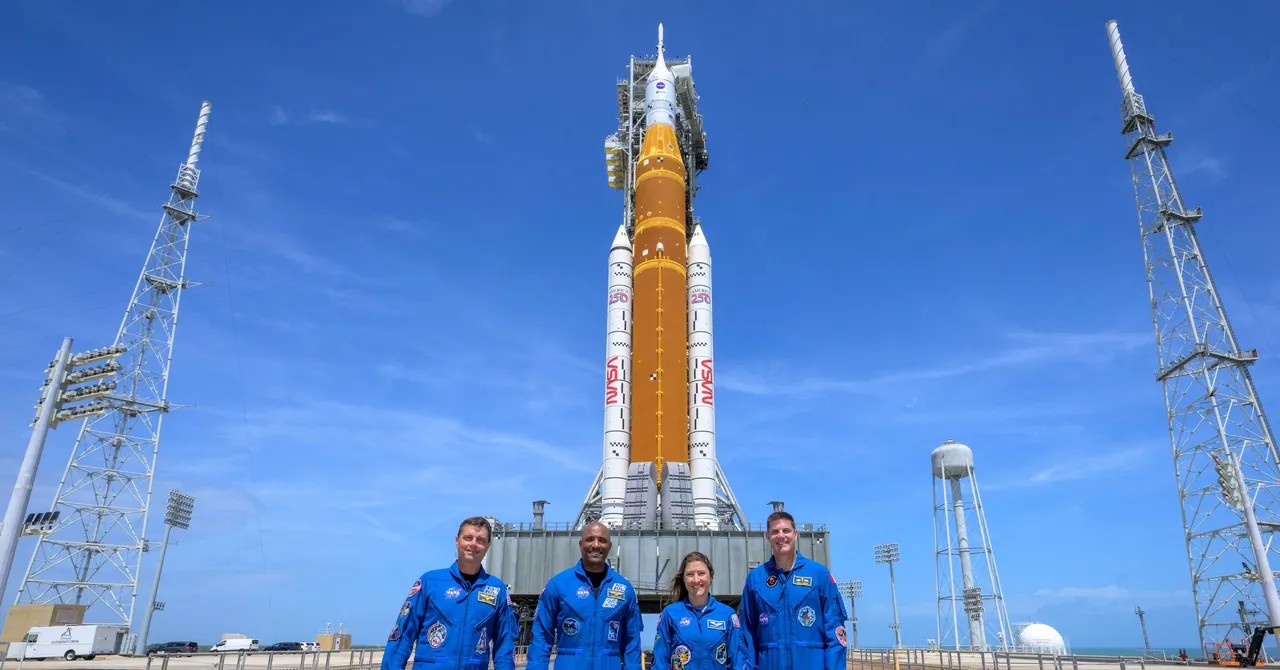
The United States is poised to resume crewed missions beyond Earth orbit for the first time in over five decades, with the launch of Artemis II. This mission isn’t merely a technical achievement; it represents a significant step toward broader representation in space exploration, featuring the first woman, first person of color, and first non-American astronaut to travel to the lunar environment.
The crew selection, announced in 2020, was described by then-NASA Administrator Bill Nelson as “the crew of humanity,” reflecting a deliberate effort to embody diversity in a field historically dominated by a narrow demographic. This mission is not just about reaching the Moon; it’s about who gets to go and what that signifies.
The launch is scheduled for April 1. Approximately eight minutes after liftoff, the Orion spacecraft will enter space, performing an Earth orbit before beginning its lunar trajectory. The spacecraft will approach within 6,450–9,650 kilometers of the lunar surface before returning for a splashdown landing. The mission’s ten-day duration will be critical for evaluating Orion’s operational and life support systems – a key step toward NASA’s goal of returning humans to the lunar surface by 2028.
The Artemis II Crew: A New Generation of Explorers
The four-person crew brings a wealth of experience from military aviation, engineering, and long-duration spaceflight. Their combined expertise will be essential for a mission that serves as a crucial testbed for future deep-space travel, including eventual missions to Mars.
Reid Wiseman: Commander
A 27-year veteran of the US Navy and a decorated test pilot, Reid Wiseman will lead Artemis II. His background includes a bachelor’s in computer systems engineering, a master’s in systems engineering, and specialized training in space systems. In 2014, he spent 165 days on the International Space Station (ISS) as a flight engineer, accumulating over 13 hours in spacewalks and participating in hundreds of scientific experiments.
Wiseman views his greatest personal challenge as single parenthood, highlighting the human side of even the most technically demanding professions.
Victor J. Glover: Pilot
Victor Glover, the first Black person to travel to deep space, is a combat-tested naval aviator with over 3,500 flight hours in 40 aircraft types. He flew 24 combat missions and over 400 carrier landings. Selected as a NASA astronaut in 2013, Glover piloted SpaceX Crew-1 in 2020, spending 168 days on the ISS and performing four spacewalks. His role on Artemis II is a historic moment for representation in space exploration.
Christina Koch: Mission Specialist
Christina Koch is an electrical engineer and physicist with extensive experience in extreme environments. She holds multiple degrees from North Carolina State University and worked at NASA Goddard Space Flight Center, the US Antarctic Program, and the National Oceanic and Atmospheric Administration. Koch holds the record for the longest single spaceflight by a woman, spending 328 consecutive days on the ISS, including six spacewalks totaling over 42 hours of extravehicular activity. Her scientific contributions span robotics, bioprinting, and materials science.
Jeremy Hansen: Mission Specialist
Jeremy Hansen, the first Canadian to travel to the Moon, brings a background in military aviation and physics. A former CF-18 fighter pilot, he served as a CapCom at Mission Control and participated in analog missions simulating extreme conditions, including underwater stays in the NEEMO habitat. He also led a class of NASA astronauts, overseeing their training.
The Artemis II mission represents not just a technical feat but a deliberate shift toward inclusivity in space exploration. It is a testament to the idea that the future of space travel is one where humanity’s diversity is reflected among those who reach for the stars. The success of this mission will be a critical stepping stone toward NASA’s long-term goals, including crewed missions to Mars and the establishment of a sustainable lunar presence.