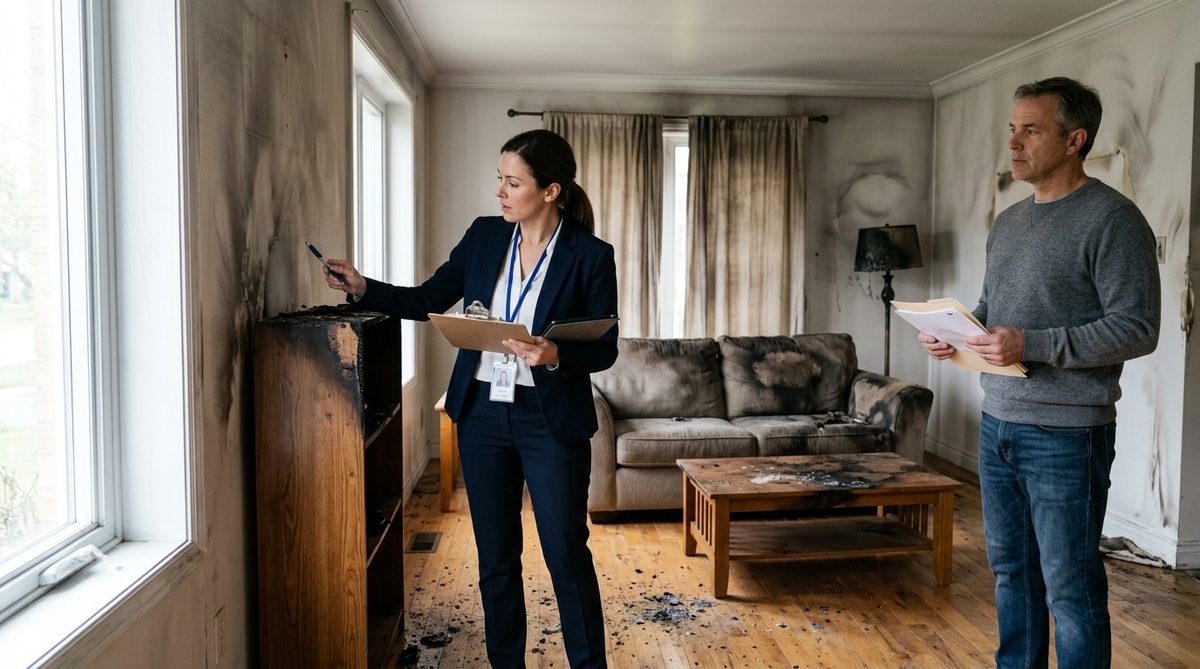
Every month, that automatic deduction for home insurance quietly leaves your bank account. It is easy to forget about it, much like a mobile phone plan or a streaming subscription. Then, the day comes. Smoke blackens the walls. The roof collapses. An expert appointed by your insurance company knocks on the door of your temporary housing.
This is when the questions hit hard. Precise. Methodical. What brand? What model? What was the purchase date? What was the price?
Without answers, your compensation melts away like snow in the sun.
With the summer heat and the rising frequency of forest fires in Gironde, Landes, and Var, this reality is striking thousands of French households. It highlights a simple reflex that changes everything—a habit that too few homeowners and renters apply before it is too late.
The Fire That Changed Everything: When Proof Matters Most
After a wildfire, compensation for a damaged home relies on the fire coverage within your multi-risk home insurance policy, not the natural disaster regime.
Practically speaking, this triggers a standard claims process. You must declare the incident within five working days, even if your file is incomplete. Then, the expert arrives. Their job is to assess damage to the structure and the contents.
This is where the cold shower begins.
The expert does not just note the charred walls. They calculate values. A burnt sofa is worthless without proof of purchase. A melted television, a destroyed washing machine, a wardrobe turned to ash—everything must be justified.
Without invoices, without photos, without bank traces, the insurer applies a flat-rate value. This rate is often far below the reality. The result is brutal. Years of premiums paid. Compensation that covers barely a quarter of what was lost.
Insurers have announced exceptional measures in light of recent fires. This includes covering temporary relocation and extending declaration deadlines. But these are always conditional on presenting proof.
Invoices and Photos: The Allies You Must Protect from Day One
The rule is simple. To be compensated for the true value of your belongings, you must prove what you owned.
This requires a methodical inventory of movable assets. This includes furniture, appliances, high-tech gadgets, clothing, jewelry, and dishware. You must systematically keep proof of purchase.
Thermal tickets fade in a few months. Scan them. Photograph them. For gifts or items without receipts, a simple dated photo serves as the beginning of proof.
When a claim occurs, photograph all damage before any cleaning. Keep the affected items until the expert passes through. Attaching as many documents as possible to your initial declaration speeds up the assessment. It avoids endless back-and-forth with the claims manager.
Be warned. Producing a fake invoice to inflate the loss can cost you everything. Case law is firm. A falsified document leads to the total loss of your right to compensation for the entire claim.
The Documents You Need to Gather
Here is a synthetic overview of the documents to gather and store outside your home.
| Type of Item | Ideal Proof | Backup Solution |
|---|---|---|
| Appliances, High-tech | Purchase invoice, warranty | Bank statement, confirmation email |
| Furniture | Invoice, delivery note | Dated photo inside the home |
| Clothing, Textiles | Grouped receipt tickets | Photos of the wardrobe, closet |
| Jewelry, Valuables | Certificate, expert appraisal | Detailed photos, estimation |
| Gifts, Antique Objects | Dated photo | Sworn statement |
Good Habits to Never Live This Administrative Nightmare Again
The first habit takes only a few minutes a month. Classify digital invoices in a dedicated folder. Photograph every new important purchase while it is still in its original packaging.
Once a year, take a tour of the apartment with your camera. Film room by room. Drawers open. Cupboards visible. This is the most effective proof in case of fire or burglary.
Second indispensable reflex: save these documents outside the home. A USB drive given to a relative. A secure cloud space. A dedicated email box. It does not matter which medium you choose, as long as it survives the flames. The file stored on the living room computer has no value if that computer burns with the rest.
Finally, read your contract. Check the ceiling for insured movable property. Check for exclusions. Many households are underinsured without knowing it. They discover after the fact that their policy capped out at 20,000 euros when the actual content of their home was worth double.
Home insurance is not a tax. It is a contract prepared by both sides. Paying your premium every month without building a file of proof is like contributing to a void.
With forest fire episodes multiplying and companies reinforcing documentary requirements, taking half a day to photograph your interior and save your invoices can mean a difference of several thousand euros.
If the true financial gesture of the summer was not to compare contracts, but to finally take an inventory of what you own?
The smoke clears. The expert leaves. The check arrives. Or it doesn’t. The difference was in the drawer you remembered to photograph.